Step OneChoose Your License Class
Before you do anything else, figure out which CDL class you actually need. The class determines which vehicles you can drive, and getting the wrong one means restarting the process. Alabama issues three classes:
| Class | Vehicle Type | Who Needs It |
|---|---|---|
| Class A | Any combination vehicle with a GCWR over 26,001 lbs where the towed unit exceeds 10,000 lbs | Over-the-road truckers, semi drivers, tanker operators |
| Class B | Single vehicle over 26,001 lbs GVWR, or towing a vehicle under 10,000 lbs | Dump truck, bus, straight truck, and box truck operators |
| Class C | Vehicles designed for 16+ passengers or transporting HazMat requiring placards | Passenger van and shuttle drivers, HazMat transport |
✓ Recommendation
If you're entering the trucking industry for the first time, get a Class A. It takes the same amount of effort as Class B, opens significantly more job opportunities, and allows you to legally operate Class B and C vehicles as well. Most OTR trucking employers specifically require Class A.
Getting a Class B CDL?
Class B covers straight trucks, box trucks, buses, and dump trucks — no tractor-trailer required. See our Class B CDL Alabama guide for requirements, schools, and job types.
Step TwoConfirm You Meet Basic Requirements
Before spending money on physicals or tests, verify you meet Alabama's baseline eligibility requirements:
- ✓Age: At least 18 for intrastate (within Alabama only) driving; 21 for interstate (crossing state lines) or HazMat. Most employers require 21 regardless.
- ✓Residency: Must be an Alabama resident with a valid Alabama driver's license.
- ✓License in good standing: Your regular Alabama driver's license must not be suspended, revoked, or expired.
- ✓One license only: You cannot hold licenses from multiple states. Surrender any out-of-state licenses before applying.
- ✓No disqualifying offenses: Recent DUI convictions, certain felonies, or multiple serious traffic violations may disqualify you. See the requirements page for the full list.
- ✓English proficiency: Must read and speak English well enough to understand road signs and respond to official inquiries.
⚠️ Transferring from Another State?
If you hold a CDL from another state, you must surrender it to ALEA and transfer your CDL to Alabama. You may not need to retake the skills test if you hold a valid out-of-state CDL. Bring your current out-of-state CDL, proof of Alabama residency, and Social Security card to any ALEA Driver License office.
Step ThreeGet Your DOT Physical
A Department of Transportation (DOT) physical is required to operate a commercial vehicle in Alabama. This is a federal requirement — your regular primary care doctor cannot perform it unless they are registered with the FMCSA National Registry of Certified Medical Examiners.
The DOT physical covers your vision, hearing, blood pressure, cardiovascular health, and general neurological function. Here's what to expect:
- ✓Vision: 20/40 acuity in each eye (with or without correction); 70-degree field of vision
- ✓Hearing: Must perceive a forced whispered voice in the better ear at 5 feet or less, with or without a hearing aid
- ✓Blood pressure: Ideally below 140/90 for a full 2-year certificate; Stage 1 hypertension may receive a 1-year certificate
- ✓Urinalysis for underlying health conditions (not a drug test, though separate drug testing may be required by employers)
- ✓Review of medical history including diabetes, sleep disorders, and cardiovascular conditions
If you pass, you'll receive a Medical Examiner's Certificate (MEC) — a small card you must carry whenever driving commercially. It is valid for up to 2 years.
📍 Finding a DOT Examiner Near You
Search the FMCSA National Registry at nationalregistry.fmcsa.dot.gov. Many urgent care clinics and occupational health centers offer DOT physicals in Alabama. Cost is typically $75–$150 out of pocket. Call ahead to confirm they're on the national registry.
Once you have your Medical Examiner's Certificate, you'll need to submit it to ALEA as part of the self-certification process. This can be done online at alabamadl.alea.gov/alea — no office visit required.
Step FourStudy and Pass the CDL Knowledge Test
The Alabama CDL general knowledge test has 50 multiple-choice questions. You need to answer at least 40 correctly (80%) to pass. The test is taken in person at an ALEA Driver License office — you cannot take it online.
The general knowledge test covers the following topic areas from the Alabama CDL Manual:
- ✓Driving safely — space management, speed, and visibility
- ✓Shifting gears and vehicle systems
- ✓Braking distances and stopping rules
- ✓Pre-trip inspection procedures
- ✓Cargo securement and weight distribution
- ✓Hazardous conditions (fog, ice, wind)
- ✓Skid control and vehicle handling emergencies
- ✓Alcohol and drug regulations (0.04% BAC rule)
- ✓Accident procedures
CDL Endorsement Tests
If you want endorsements on your CDL, you'll take additional knowledge tests at the same time (or add them later). Common endorsements include:
📖 How to Study
Download the free Alabama CDL Driver's Manual from the ALEA website and read it cover to cover — especially Sections 1–8. Then take practice tests repeatedly until you're consistently scoring 90%+. Our free 40-question practice test covers the same topic areas as the real exam.
Complete Your ELDT Theory Requirement Online
StartCDL offers FMCSA-approved online CDL theory courses — including ELDT, HazMat endorsement, and restriction removal courses you can complete from anywhere in Alabama. No need to wait for a class start date. Explore online CDL courses at StartCDL →
Affiliate link — we may earn a commission at no cost to you.
Step FiveObtain Your Commercial Learner's Permit (CLP)
Once you pass the knowledge test, ALEA will issue your Commercial Learner's Permit (CLP). This allows you to practice driving a commercial vehicle on public roads — but only with a CDL holder who holds the appropriate class and endorsements in the passenger seat.
| CLP Rule | Details |
|---|---|
| Minimum holding period | 14 days — you cannot take your skills test until at least 14 days after your CLP was issued |
| Validity | 1 year from date of issue |
| Supervisor requirement | A CDL holder with the appropriate class and endorsements must be in the passenger seat whenever you operate a CMV on public roads |
| HazMat restriction | CLP holders may NOT transport HazMat requiring placards |
| Passenger restriction | CLP holders with a P endorsement may not transport passengers (other than the CDL supervisor) during the behind-the-wheel skills test |
| Cost | $36.00 |
✓ What to Bring to ALEA
Bring your valid Alabama driver's license, Social Security card (or W-2), proof of residency, your Medical Examiner's Certificate, and payment for the CLP fee ($36). If you have a prior out-of-state license, bring that as well — you'll surrender it at this visit.
CLP Training Program Requirements (ELDT)
As of February 7, 2022, federal law requires all first-time Class A and B CDL applicants to complete an approved Entry-Level Driver Training (ELDT) program through an FMCSA-registered Training Provider before taking their CDL skills test. This is sometimes called a "CLP training program."
- ✓Your CLP training program must be completed at an FMCSA-registered Training Provider — verify any school at fmcsa.dot.gov before enrolling
- ✓The training covers both theory (classroom) and behind-the-wheel practice
- ✓Most Alabama CDL schools are already FMCSA-registered and satisfy ELDT automatically
- ✓Company-sponsored training programs (Werner, Schneider, Swift, etc.) also qualify as ELDT
- ✓You cannot take your CDL skills test until both your 14-day CLP hold AND your ELDT are complete
What counts as a CLP training program?
Any FMCSA-registered CDL school, community college CDL program, or company-sponsored training program qualifies. See our Alabama CDL Training Schools directory for a list of registered providers by city.
Step SixComplete Your CDL Training
With your CLP in hand, you now need to develop the skills to pass the CDL skills test. You have two main paths:
Option A: Enroll in a CDL Training School
Professional CDL schools provide structured behind-the-wheel training, typically running 4–8 weeks. They supply the truck, the training, and often help you schedule your skills test. Cost runs $3,000–$8,000 depending on the school and program length.
- ✓Best if you have no prior experience with large vehicles
- ✓Schools often have relationships with trucking companies that hire directly from their graduates
- ✓Some programs offer payment plans or financing
See our Alabama CDL Training Schools directory for a full list of options by city.
Option B: Company-Sponsored CDL Training (Free CDL)
Many large trucking carriers — including Werner, Schneider, Swift, and KLLM — will pay for your CDL training in exchange for a 1–2 year employment commitment. This is the most common path for first-time CDL drivers who want to enter the industry without paying out of pocket.
- ✓Training cost is covered — you may receive a small weekly stipend during training
- ✓You're essentially hired before you start — job is waiting on the other side
- ✓You sign a contract committing to drive for the carrier for 1–2 years post-CDL
- ✓If you leave early, you typically owe back some or all of the training cost
📋 ELDT Requirement (Post-February 2022)
As of February 7, 2022, federal law requires all first-time Class A and B CDL applicants to complete Entry-Level Driver Training (ELDT) from an FMCSA-registered Training Provider before taking the skills test. Most accredited CDL schools are already FMCSA-registered. Verify this before enrolling — unregistered programs do not satisfy this requirement.
Step SevenPass the CDL Skills Test
The CDL skills test is a three-part exam administered at an ALEA-approved Third-Party Skills Test location. You must pass all three parts in the same vehicle class you're applying for. The test fee is approximately $50 per attempt.
Part 1: Pre-Trip Vehicle Inspection
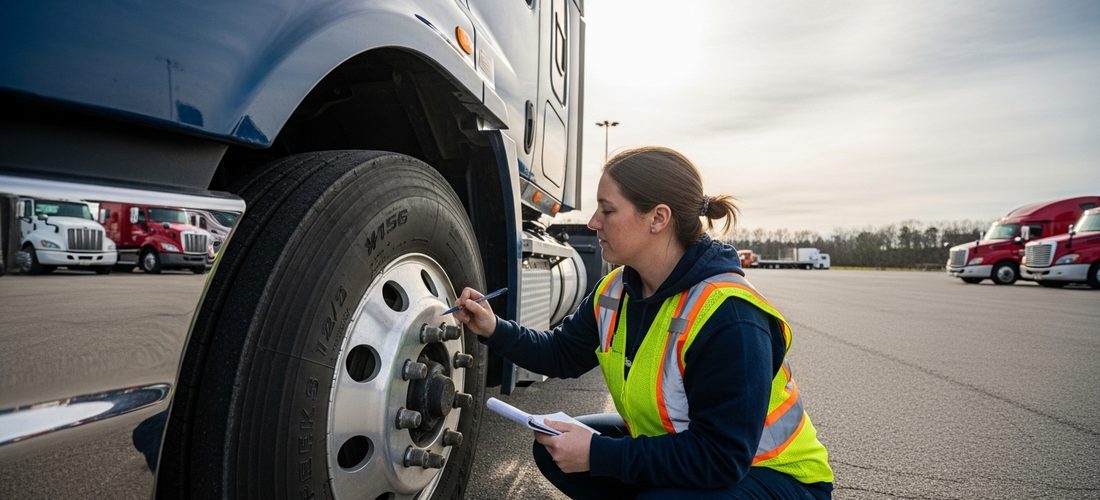
You'll be asked to perform and narrate a thorough pre-trip inspection of the vehicle — explaining what you're checking and why. Examiners are looking for knowledge and thoroughness. You should be able to identify and explain every major component: brakes, tires, lights, mirrors, coupling system, and emergency equipment.
Part 2: Basic Vehicle Control
Conducted in a closed testing area (not on public roads), this section tests your ability to maneuver the vehicle through a series of exercises including Forward Stop, Forward Offset Tracking, straight-line backing, and offset backing (alley dock), and parallel parking. You'll lose points for pulling up, hitting cones, or requiring multiple attempts.
Part 3: On-Road Driving Test
A 45–60 minute drive on public roads with an examiner in the cab. They'll evaluate your ability to manage intersections, lane changes, turning, merging onto highways, managing grades, and following hours of service rules in practice. Stay calm, communicate your actions, and default to safety.
✓ Skills Test Tips
Practice your pre-trip narration out loud at home before test day — examiners want to hear you explain what you're checking, not just touch the vehicle. For backing exercises, take it slow and use all your mirrors. On the road test, exaggerate your mirror checks so the examiner can clearly see you're using them.
Step EightGet Your Alabama CDL Issued
After passing your skills test, visit an ALEA Driver License office to convert your CLP to a full CDL. Bring:
- ✓Your current Alabama CLP
- ✓Your skills test results (your third-party tester will provide documentation)
- ✓Your valid Medical Examiner's Certificate (if not already on file)
- ✓Payment for CDL issuance fee ($36)
- ✓Your completed self-certification form (if not submitted online already)
ALEA will issue your Alabama CDL, which is valid for 4 years. Your CDL will display your license class, any endorsements you've earned, and any applicable restriction codes (e.g., "E" if you require corrective lenses).
📋 Don't Forget: Self-Certification
You must self-certify your type of commercial driving operation (interstate vs. intrastate, excepted vs. non-excepted) to ALEA. Most drivers will select Non-Excepted Interstate (NI), which requires you to keep a valid Medical Examiner's Certificate on file. This can be done online at alabamadl.alea.gov/alea before or after your CDL is issued.
🎉 You Did It — What's Next?
With your CDL in hand, check out our training schools page for job placement resources, or head to Alabama CDL Jobs to find open positions. Starting pay for new Class A CDL holders in Alabama typically ranges from $47,000–$62,000/year depending on the carrier and route type.